
Understanding the Hidden Chemistry of Florida Pools
If you’ve ever tested your pool water in Port Charlotte, Punta Gorda, North Port, or Rotonda and noticed the pH levels changing overnight, you’re not alone. Many homeowners across Charlotte County experience mysterious pH swings—one evening, your pool reads a perfect 7.4, and by morning, it’s climbed to 8.0 or dropped to 7.0.
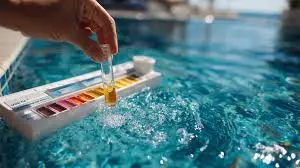
So what’s happening beneath the surface? Let’s dive into the science behind pool pH and how Florida’s unique environment plays a big role.
🌴 What pH Really Means for Your Pool
In simple terms, pH measures how acidic or basic your pool water is, on a scale of 0–14:
- 7.0 = Neutral
- Below 7.0 = Acidic (can corrode metal or etch plaster)
- Above 7.8 = Basic (can cause cloudy water and scale buildup)
The ideal pool pH typically falls between 7.2 and 7.6, where water feels comfortable to swimmers and chlorine works most effectively.
But keeping that balance steady in Florida’s heat and humidity? That’s where things get tricky.
☀️ Why pH Levels Change Overnight
Pool water is constantly interacting with the environment — absorbing gases, evaporating water, and reacting to chemicals. At night, when temperatures drop and the water rests, several processes cause your pH to shift:
1. Carbon Dioxide Exchange
During the day, agitation from swimmers, pumps, and sunlight drives carbon dioxide (CO₂) out of the water. As CO₂ escapes, pH rises.
At night, CO₂ reabsorbs from the air, which can lower the pH slightly.
In short:
- Hot, sunny days → pH rises.
- Cool, still nights → pH drops or stabilizes.
2. Algae Respiration
Even tiny algae or microorganisms release CO₂ at night.
If your pool in North Port or Punta Gorda has even mild algae growth, nighttime CO₂ release can cause pH drops while you sleep.
3. Evaporation and Humidity
In Charlotte County’s humid coastal climate, evaporation rates can vary widely. As water evaporates, dissolved solids concentrate—raising alkalinity and causing pH drift upward.
4. Chemical Imbalances
If your chlorine stabilizer (CYA) or alkalinity is off, the pH becomes unstable.
For example:
- High alkalinity = hard to lower pH.
- Low alkalinity = wild pH swings, especially overnight.
⚗️ The Chemistry Behind It All
Water seeks balance. When chemical reactions, environmental gases, or temperature shifts alter its makeup, your pH changes accordingly.
Here’s what’s happening at a molecular level:
- CO₂ + H₂O ⇌ H₂CO₃ ⇌ H⁺ + HCO₃⁻
- More CO₂ in the water → more carbonic acid → lower pH.
- Less CO₂ (after daytime aeration) → higher pH.
This reversible reaction is why Florida pools often see daily pH cycling—a totally natural process that needs careful monitoring.
💧 How to Keep pH Stable in Florida’s Climate
Living in Punta Gorda, Rotonda, or Port Charlotte, you can’t stop humidity or temperature shifts—but you can stabilize your pool chemistry.
🧪 1. Test pH and Alkalinity Regularly
- Test every 2–3 days, especially after rain or heavy pool use.
- Ideal alkalinity range: 80–120 ppm.
- Keep pH between 7.2–7.6 for chlorine efficiency.
🌀 2. Control Aeration
Excessive splashing, waterfalls, or fountains can speed up CO₂ loss, raising pH.
If you see your levels climbing, reduce aeration or run features less often.
🌧️ 3. Balance After Florida Rain
Storms in Charlotte County introduce acidic rainwater, lowering pH fast.
After storms:
- Test immediately.
- Add a pH increaser if it drops below 7.0.
- Brush and circulate to mix chemicals evenly.
🌞 4. Use Pool Covers Overnight
Covers prevent gas exchange, stabilize evaporation, and keep debris out.
This can help maintain consistent pH overnight in humid climates like North Port.
🔬 5. Add a Stabilizer or Buffer
Products like borates or sodium bicarbonate help resist sudden pH swings.
Ask your local Florida Detail expert about long-term pH buffering solutions.
🧰 Real Example from Port Charlotte
A homeowner in Port Charlotte noticed their pH climbing every night, despite balanced alkalinity. After inspection, the culprit was identified: an overactive aeration feature running all night.
Once they reduced water agitation and added borates, pH remained stable for weeks.
Small environmental tweaks can make a huge difference in maintaining chemistry equilibrium.
🔗 Helpful Resources
For more expert pool tips, visit:
- Florida Detail – your trusted directory for pool cleaning in Charlotte County and surrounding areas.
- UnlimitedManiac.com – for SEO and small business marketing insights.
- PoolServiceInPortCharlotte.com or NorthPortPoolServices.com – local specialists who understand Florida’s climate challenges.
Also explore our:
🏁 Conclusion: The Key to Consistent Pool Chemistry
In the ever-changing Florida climate, your pool is a living ecosystem. Understanding the science behind pH shifts helps you stay ahead of issues like cloudy water, scaling, and chlorine loss.
Keep a close eye on your pH readings—especially overnight—and consult your local Charlotte County pool expert via Florida Detail.
With the right balance of chemistry and care, your pool will stay sparkling clear year-round.


