
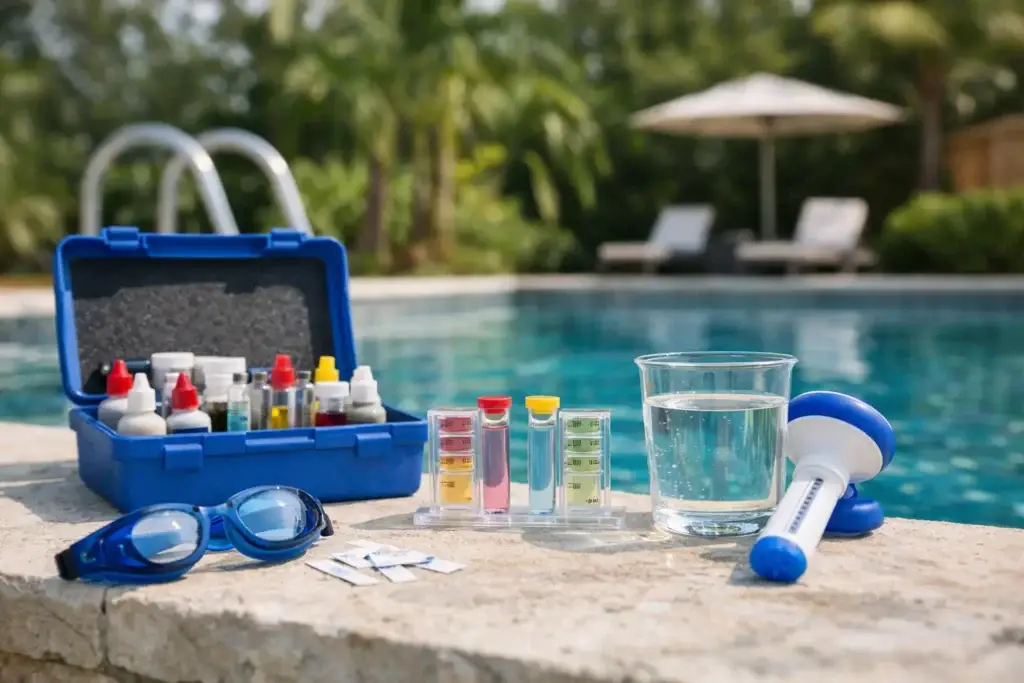
A good pool water test kit can save you from guessing why the water looks dull, why chlorine disappears overnight, or why the tile line is starting to feel rough. In this pool water test kit review, we are looking at what actually works for homeowners in Southwest Florida, where heat, heavy rain, long swim seasons, and strong sun put pool chemistry under constant pressure.
The best kit is not automatically the most expensive one. It is the one you will use correctly, understand clearly, and trust enough to act on before a small chemistry issue becomes green water, staining, scale, or an equipment headache.
What a Pool Test Kit Needs to Measure
For routine residential pool care, your test kit should measure free chlorine, pH, total alkalinity, and stabilizer, also called cyanuric acid or CYA. Those are the core numbers behind clean, comfortable water. If your pool has a salt system, calcium hardness testing is also valuable because saltwater pools can still develop scale, especially when calcium and pH run high.
Free chlorine tells you how much active sanitizer is available to protect the water. Total chlorine can also be useful, because the difference between total and free chlorine points to combined chlorine, the material that often causes a sharp chemical smell and irritated eyes. A pool that smells strongly of chlorine may not have too much chlorine. It may need better sanitation and oxidation.
pH and alkalinity work together. High pH can make chlorine less effective and encourage scale. Low pH can be uncomfortable for swimmers and hard on surfaces and metal equipment. CYA matters even more under the Florida sun because it protects chlorine from burning off too quickly. Too little stabilizer wastes chlorine. Too much can make chlorine sluggish and difficult to manage.
Pool Water Test Kit Review: The Three Main Types
Test strips: fast, simple, and limited
Test strips are the quickest option. Dip the strip, wait the stated number of seconds, then match the colors to the chart. They are convenient for a quick check before guests arrive, after a big rainstorm, or when you suspect the chlorine has dropped.
The trade-off is precision. Color matching can be subjective in bright sun, and strips can become unreliable when the container is left open, stored in a hot garage, or exposed to humidity. In coastal and inland Southwest Florida alike, heat and moisture are not minor details. A strip bottle that lives beside the pool pump all summer may give you a false sense of security.
Choose strips that read at least free chlorine, pH, alkalinity, and CYA. For basic homeowner monitoring, they are useful. For troubleshooting cloudy water, algae, persistent scale, or a chemical adjustment that keeps failing, strips alone are usually not enough.
Liquid reagent kits: the best value for dependable testing
A liquid drop kit is the practical choice for pool owners who want more reliable numbers without moving into professional-grade equipment. You collect a water sample, add measured drops of reagent, and compare the resulting color or count drops until the sample changes color.
This process takes a few minutes longer than a strip, but it provides a clearer reading and teaches you what the water is doing. Better kits can measure free and combined chlorine separately, along with pH, alkalinity, calcium hardness, and CYA. That extra information matters when the water appears fine but algae keeps returning or a salt cell starts collecting scale.
The downside is that reagents expire. Keep bottles tightly closed, out of direct sunlight, and away from extreme heat. Replace old reagents rather than assuming the number is right. A well-made liquid kit is often the best all-around choice for a homeowner who handles some maintenance personally and wants to avoid overcorrecting the water.
Digital readers and photometers: clear results at a higher cost
Digital testers and photometers remove much of the color-chart guesswork. Depending on the model, you add a tablet or reagent to a sample and receive a digital result. They can be especially helpful for people who have trouble distinguishing shades of chlorine, pH, or alkalinity on a comparator block.
These tools can be highly accurate, but they are not maintenance-free. The sample cell must be clean, the test method must be followed exactly, and replacement tablets or reagents add ongoing cost. Some lower-priced digital pens only test pH or total dissolved solids, not the full chemistry needed to maintain a swimming pool.
For a homeowner who wants detailed records or manages multiple properties, a quality photometer may be worth it. For most pools, a dependable liquid kit plus consistent testing provides better value.
What We Would Skip
Avoid kits that only test pH and chlorine. Those readings are helpful, but they do not explain why chlorine is hard to hold or why the water balance keeps drifting. A pool can show an acceptable pH and chlorine reading while CYA, alkalinity, calcium, or phosphates are contributing to a larger issue.
Be cautious with app-based test systems that promise instant answers from a phone photo. Lighting, camera settings, and sample handling can influence results. They can be convenient, but they should not replace a reliable manual test when you are making a meaningful chemical adjustment.
Also skip expired clearance kits. A bargain is not a bargain if the reagents have been sitting in heat for two seasons. Accurate water testing is preventive maintenance, and preventive maintenance costs less than draining water, treating algae, replacing damaged equipment, or acid washing a stained surface.
How to Get a Reading You Can Trust
Even an excellent kit produces poor information if the sample is collected incorrectly. Take water from elbow depth, away from skimmers, return jets, and chemical feeders. Test before adding chemicals whenever possible, and do not test immediately after shocking the pool unless you are specifically checking the chlorine level.
Run the pump long enough to circulate the water before testing. After a storm, a heavy swim day, or a large chemical addition, give the pool time to mix. Testing a pocket of poorly circulated water can lead to unnecessary adjustments.
Follow the kit instructions exactly. More drops are not better. Extra waiting time can change a color reading. And when a result seems surprising, test a second sample before adding several products at once. Chasing numbers with one chemical after another is how pool water gets out of balance fast.
For most Florida pools, testing chlorine and pH two to three times per week is sensible during hot weather or periods of frequent use. Alkalinity, CYA, and calcium hardness can usually be checked weekly or every couple of weeks, depending on the pool, water source, and maintenance routine. After major rain, check the water sooner. Rain can dilute sanitizer and shift balance, while wind and runoff add debris that feeds algae.
A Test Kit Is a Tool, Not a Maintenance Plan
Testing tells you what the water needs at that moment. It does not remove leaves, brush walls, vacuum debris, clean filters, inspect baskets, or spot a weak pump, failing salt cell, or developing algae bloom. That is why clear water can still be heading in the wrong direction when regular pool care is missed.
Pool chemistry is also connected to the condition of the pool itself. A dirty filter can reduce circulation. Poor circulation creates dead spots. Dead spots invite algae. Then chlorine demand rises, and a test strip may only show the symptom, not the cause. Detail-oriented maintenance looks at the whole system, not one square on a color chart.
Florida Detail Pools sees this regularly in Port Charlotte, North Port, and Punta Gorda: a homeowner has added chlorine several times, but the pool remains cloudy because the filter needs attention, the stabilizer is out of range, or algae has taken hold where brushing was skipped. The right test kit helps catch the warning signs early, but consistent hands-on service keeps those warning signs from becoming a weekend project.
Our Straight Answer
For most homeowners, a quality liquid reagent kit is the strongest choice. Keep test strips on hand for quick checks if you like the convenience, but use the liquid kit when you are adjusting chemicals or trying to solve a problem. Consider a digital photometer only if you enjoy detailed testing, need precise records, or manage more than one pool.
The goal is not to turn pool ownership into a chemistry class. The goal is clean, balanced, comfortable water that stays ready for use. If your test results keep changing, chlorine will not hold, or the pool is starting to look off, treat that as an early warning. A timely check and the right maintenance can keep a small water issue from taking over the whole pool.