
Keeping your pool water clean and balanced is more than just chemistry — it starts with the right circulation. A pump that is too small will under-filter and allow algae to bloom; one that’s too large will waste energy and stress equipment. In this guide, Florida Detail shows you exactly how to match gallons per minute (GPM) with your pool’s volume, especially for pools in Port Charlotte, Punta Gorda, North Port, Rotonda, and throughout Charlotte County.
Whether your pool sees heavy sun exposure, storm runoff during rainy seasons, or sudden algae challenges during Florida’s summer heat, getting the pump sizing right is critical.
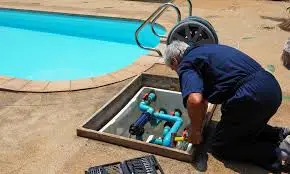
H2: Why Proper Pump Sizing Matters in Southwest Florida
In Charlotte County and surrounding towns like Punta Gorda and North Port, pool owners face unique challenges:
- High heat & UV stress: Rapid chlorine depletion demands stronger circulation.
- Storm runoff & debris: Heavy rains introduce organic load; higher turnover helps cope.
- Seasonal users & snowbirds: Pools may sit dormant; you’ll want a pump that can ramp up without shock.
- Energy costs: Oversized pumps waste electricity in a region with year-round pool use.
Getting the pump wrong leads to poor water, higher bills, and equipment wear. Let’s break down the steps.
H2: Step 1 – Calculate Your Pool Volume (in gallons)
First, determine how many gallons your pool holds. This depends on shape, depth, and dimensions. Here are basic formulas:
- Rectangular pool: length × width × average depth × 7.48
- Circular pool: (π × radius² × average depth) × 7.48
- Irregular shapes: divide into consistent zones, sum volumes
Once you have volume (V), use that as the basis for pump sizing.
H2: Step 2 – Turnover Rate & Flow Rate Targets
“Turnover” is how many times per day the pump should circulate the entire pool volume. In Florida, you should aim for at least once per 24 hours, and often once per 6–8 hours for optimal clarity and sanitation.
Formulas:
- Minimum filtration flow rate = V ÷ 1,440 minutes (i.e. full turnover in 24 h)
- Maximum (design) flow rate = V ÷ 360 minutes (i.e. turnover in 6 h) basc.pnnl.gov+2AQUA Magazine+2
Example: If your pool is 30,000 gallons,
- Min flow = 30,000 ÷ 1,440 ≈ 20.8 GPM
- Max design flow = 30,000 ÷ 360 = 83.3 GPM
However, you must also respect your pipe size limits and pump curve. inyopools.com+1
Pipe limits:
- 1½″ PVC is often limited near 45 GPM
- 2″ PVC can handle up to ~80 GPM
Going higher will increase friction and stress the system. inyopools.com+2lesliespool.com+2
Thus, even if your math says 100 GPM, your actual pump choice may need to stay within pipe constraints.
H2: Step 3 – Calculate Total Dynamic Head (TDH)
Flow is only half the story. You need Total Dynamic Head — the resistance your pump must overcome (pipe length, bends, fittings, elevation, filters, heater, valves).
What to include in TDH:
- Length of suction and return pipes
- Number of elbows, tees, valves
- Height difference (if equipment pad is above or below pool)
- Filter, heater, chlorinator head losses
Pump manufacturers provide pump curves showing GPM vs head (in feet). You’ll choose a pump whose curve intersects your system curve at the desired flow point. AQUA Magazine+2Hayward+2
H2: Step 4 – Choose the Pump Based on GPM + Head
Use these guidelines when selecting:
- Check the pump curve: ensure the operating point (your GPM at calculated TDH) lies near the pump’s best efficiency zone.
- Avoid extreme oversizing: a very high-GPM pump may push more water than pipe or filter can handle. (One Reddit user notes: “The max GPM through a 2″ intake is 73 no matter the size of the motor.”) Reddit
- Consider variable-speed models: They let you dial back flow when less is needed, saving energy. basc.pnnl.gov+2lesliespool.com+2
- Be mindful of minimum flow requirements for skimmers, chlorinators, etc. Many skimmers need ~25 GPM to operate properly. basc.pnnl.gov
H3: Practical Tips for Pools in Port Charlotte & North Port Area
- For typical residential pools (20,000–35,000 gallons) in Port Charlotte or Rotonda, aim for a pump delivering 30–60 GPM depending on plumbing.
- In hurricane season, when debris load is high, temporarily increase speed (if using variable pump) to flush contaminants.
- If your plumbing lines are older or narrower in Punta Gorda area homes, stay conservative on flow to avoid water hammer or leaks.
- For snowbird homes in Charlotte County, when pool is idle for months, ensure pump seals and dry runs are avoided by occasional test runs.
H2: Quick Checklist for Pump Sizing
| Task | What to do |
|---|---|
| 1. Volume | Compute pool gallons |
| 2. Desired turnover | Choose 24 h minimum, ideally 6–8 h design |
| 3. Flow limits | Respect pipe GPM limits (e.g. 45 GPM for 1½″) |
| 4. TDH | Estimate total dynamic head including all losses |
| 5. Pump curve match | Pick a pump whose curve fits your GPM vs head |
| 6. Optional: variable speed | Use lower flow when possible to save energy |
H2: Real Florida Example
A homeowner in North Port called us after algae blooms plagued their pool in July. Their old pump was undersized (only ~25 GPM), and with heavy sun and nutrient load, algae took hold fast. We:
- Measured their pool (28,500 gallons)
- Calculated ideal design flow (~80 GPM for 6-hour turnover)
- Surveyed their plumbing (2″ lines with moderate length and elbows)
- Selected a variable-speed pump whose curve hit 70–75 GPM at ~50 ft head
- Programmed the pump to run:
- High speed for 1–2 hours post-storm
- Moderate speed for 8 hours daily for routine filtration
- Low speed overnight for basic circulation
They reported crystal clarity and reduced chlorine use in Punta Gorda homes, even under heavy sun.
H2: Common Mistakes & Pitfalls to Avoid
- Oversizing simply by “bigger is better” — can cause cavitation, noise, energy waste
- Ignoring pipe or filter limits — pump might push more water than your system can handle
- Neglecting TDH — leads to choosing a pump that can’t actually achieve desired flow
- Underestimating future load — storms, parties, added features (jets, waterfalls)
- Skipping seasonal adjustment — your pump should flex between heavy use and lower flow when idle
H2: Why Florida Detail Recommends Expert Sizing
At Florida Detail, we’ve sized and tuned pumps all over Charlotte County — from Rotonda to North Port, Punta Gorda to Port Charlotte. We combine hydraulic calculations, site survey, and local climate insight to get the balance right.
When you call us, here’s what we do:
- Inspect plumbing layout
- Measure existing head loss
- Model pump curve vs your pool volume
- Propose an efficient variable-speed pump
- Program custom run schedules
We stand by long after install — monitoring, adjusting, optimizing.
Internal & External Linking Strategy
For readers wanting to see the full range of our services, check our Services page. For general company info or to return home, our Home page is your gateway. To request a quote or schedule a visit in Charlotte County, use Contact.
If you’re curious about local marketing or SEO tactics, check out UnlimitedManiac.com for strategies used in Florida markets.
We sometimes reference shared resources from local businesses like PortCharlottePoolService.com or NorthPortPoolCompany.com for community insight and standards in Port Charlotte and North Port areas.
Conclusion & Call to Action
Sizing a pool pump correctly is part science, part art — especially in our Florida climate with storms, UV stress, algae pressure, and seasonal dynamics. But when you match gallons per minute to your pool’s volume — accounting for plumbing, head loss, and usage patterns — you’ll get cleaner water, lower costs, and longer equipment life.
If your pool is in Port Charlotte, Punta Gorda, North Port, Rotonda, or elsewhere in Charlotte County, don’t guess. Let the experts at Florida Detail run the math and set you up right.
👉 Explore our Services directory, read more on our blog, or Contact us today to schedule a pump sizing consultation. Make the smart move — get local help that knows your pool’s needs.
Let your pool flow right — and enjoy clearer, healthier water all season long.


