Maintaining ideal pool chemistry is critical in Florida’s climate. Whether your pool is in Port Charlotte, Punta Gorda, North Port, Rotonda, or elsewhere in Charlotte County, the difference between clean, clear water and algae trouble often comes down to how accurately and frequently you test.
In this blog we’ll compare test strips vs liquid kits for pool chemistry, weigh pros/cons, and help you decide which method suits your home pool or service routine best. (If you’re curious, see our Services for full water-balance offerings.)
Why Accurate Testing Matters in Florida Pools
Florida presents some unique challenges:
- Intense sun & heat accelerate chlorine depletion
- Frequent summer storms can dump organics, algae precursors
- Snowbirds / off-season low maintenance periods lead to swings
- Salt systems, splash zones, heavy usage in communities like Rotonda or North Port
A small mis-balance in pH or chlorine can cascade into cloudy water, scaling, or algae blooms. So you want a testing method you trust.
Types of Pool Test Methods: Strips, Liquid Kits & Hybrids
Test Strips (Dip & Read)
How they work: You dip a strip into pool water, wait a few seconds, then compare the color pads to a chart.
Typical parameters: pH, free chlorine, total chlorine, alkalinity, sometimes hardness or cyanuric acid.
Liquid (Drop / Colorimetric) Kits
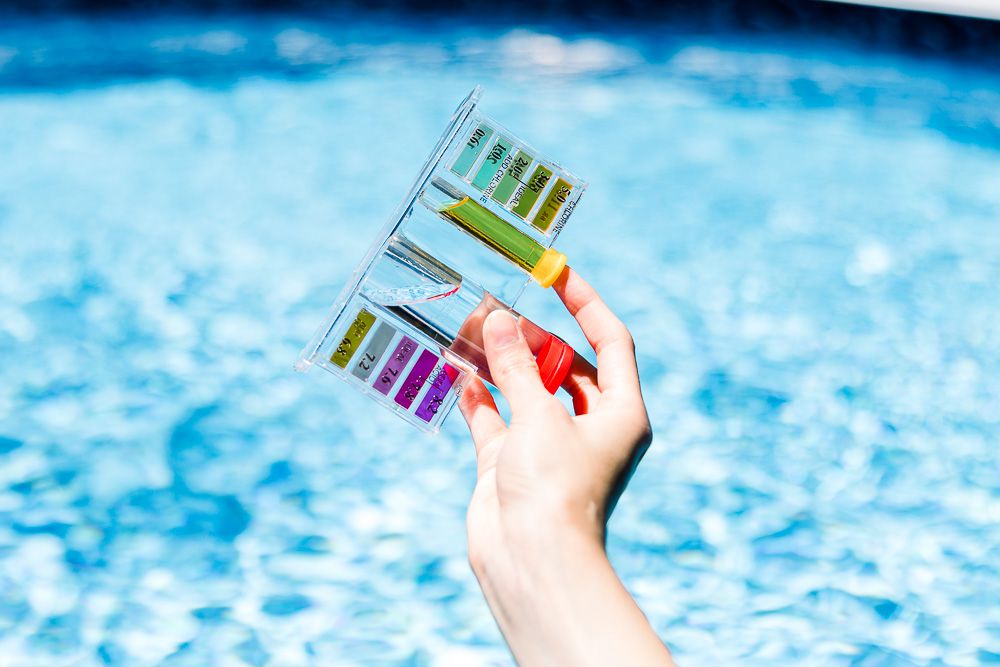
How they work: You collect a water sample, add reagents (drops) one by one, and observe color changes.
Typical parameters: More robust — free chlorine, combined chlorine, pH, total alkalinity, calcium hardness, cyanuric acid, sometimes bromine.
Hybrid / Digital Readers
Not the focus here, but worth noting: digital photometers or smartphones kits offer high accuracy, though at higher cost.
Comparison: Strips vs Liquid Kits
Below is a side-by-side look:
| Feature | Test Strips | Liquid Kits |
|---|---|---|
| Ease of Use | Very quick and simple | Requires measuring, reagents, more steps |
| Speed | Results within seconds | Takes a bit longer (drops, waiting) |
| Accuracy | Good for rough checks, less precise testyourownpool.com+1 | Higher precision, especially for free vs combined chlorine testyourownpool.com+1 |
| Range of Parameters | Limited | Broader — e.g. total alkalinity, hardness |
| Cost per test | Low | Moderate (drops cost more) |
| Shelf Life / Storage | Strips degrade in humidity | Reagents may also expire, but generally more stable if stored properly |
| Best Use Case | Quick daily checks | Weekly in-depth monitoring |
Key Takeaways
- Liquid kits typically outperform strips in accuracy, especially for free vs combined chlorine distinctions. PoolSpaForum.com+2blueoceanps.co+2
- Strips are ideal for fast, routine checks, especially between more precise tests.
- In Florida’s climate and high UV environments (like Port Charlotte or Punta Gorda), the margin for error is small, so precision matters.
Real-World Examples from Charlotte County Pools
- After a summer thunderstorm in Port Charlotte
Sudden runoff and organic load can spike combined chlorine. A strip might only show “chlorine OK,” but a liquid test could reveal elevated combined chlorine requiring a shock. - Snowbirds return in Rotonda
A pool sitting idle can drift in pH and alkalinity. Liquid tests will let you fine-tune balance before heavy use resumes. - Commercial / shared pool in North Port
Frequent bather load means tight control of free chlorine vs combined. You’ll want the more accurate liquid kit data.
How to Use Each Method Effectively
Best Practices for Test Strips
- Dip 6–12 inches under surface, hold 2–3 seconds
- Remove horizontally (so reagent doesn’t run)
- Immediately compare colors to chart under shade
- Rotate between strips and a liquid kit for verification
Best Practices for Liquid Kits
- Rinse sample vial before collecting
- Add drops slowly, one at a time
- Gently swirl — don’t shake
- Observe color change exactly when reagent guidance says
- Use clean glassware — no cross-contamination
Routine Schedule Suggestion
- Daily or alternate days: strip check for pH and chlorine
- 2–3× per week: full liquid kit panel including alkalinity, hardness
- After storms or heavy use: always run a full liquid panel
Pros & Cons Summary
✅ Advantages of Test Strips
- Very fast and easy
- Inexpensive per test
- Good for quick routine monitoring
❌ Disadvantages of Test Strips
- Less accurate, especially for composite/combined values
- Fewer parameters tested
- Color mismatch in bright sun can mislead
✅ Advantages of Liquid Kits
- Higher precision, better resolution
- Broader parameter coverage
- Better for corrective chemistry (e.g. balancing treatment)
❌ Disadvantages of Liquid Kits
- Slower and more steps
- Requires reagent supply
- Slightly higher per-test cost
Choosing What’s Best for Your Pool Service in Charlotte County
If you’re operating a local pool service company or managing multiple properties across Port Charlotte, North Port, or Punta Gorda, here’s a decision guide:
- For casual homeowners or weekly service
Test strips may suffice, especially if combined with periodic liquid checks. - For full pool service / maintenance contracts
Use liquid kits (or photometers) as the backbone of testing. Strips can be supplemental. - For resort or HOA pools with heavy use
You’ll want highest accuracy. Liquid kits or digital analyzers—strips as backup. - Budgeting & training
Liquid kits require a bit more training, but the improved accuracy often offsets the cost via fewer chemical missteps.
Integration with Local SEO & Service Messaging
At Florida Detail, we use liquid kits and digital tools to deliver pinpoint chemical balance in Punta Gorda, Port Charlotte, North Port, Rotonda, and the greater Charlotte County area. Our field technicians double-check with strips for quick spot-readings, but rely on liquid reagents for deeper diagnostics.
When you hire us (see the Home page or Contact page), you’re getting service backed by data, not guesswork.
We also regularly publish educational content like this and other pool care articles in our blog—see more in our blog library.
We collaborate with local partner directories such as PortCharlottePoolService.com and PoolServiceInPortCharlotte.com to strengthen our regional reach and ensure you find the right service in your neighborhood.
For marketing and regional SEO insights, we also refer to local knowledge sources like UnlimitedManiac.com to stay current with Charlotte County trends.
Top Tips & Facts (Quick List)
- Use strips for a quick daily check, liquid kits for in-depth weekly diagnostics
- After heavy rain or loading, always run a full liquid kit test
- Store reagents and strips in a cool, dry spot — high humidity degrades accuracy
- For best accuracy, test mid-afternoon (not in direct blazing sun, not just after pool start)
- Track results over time — chemistry drift is predictable in Florida
Conclusion & Call to Action
Understanding the difference between pool chemistry test strips vs liquid kits is more than academic — it’s essential in Florida’s climate, especially across Port Charlotte, Punta Gorda, North Port, Rotonda, and Charlotte County. Strips can offer fast spot checks, but liquid kits deliver the precision needed to prevent algae, scaling, or costly chemical corrections.
If you’re managing a residential or community pool and want confident, professional care backed by data, explore our Services or reach out via Contact. Let our expertise at Florida Detail guide your pool toward consistent clarity and safety.
Browse our directory of trusted local pool service companies and get connected to the best provider in your area—your pool deserves the right partner.


