
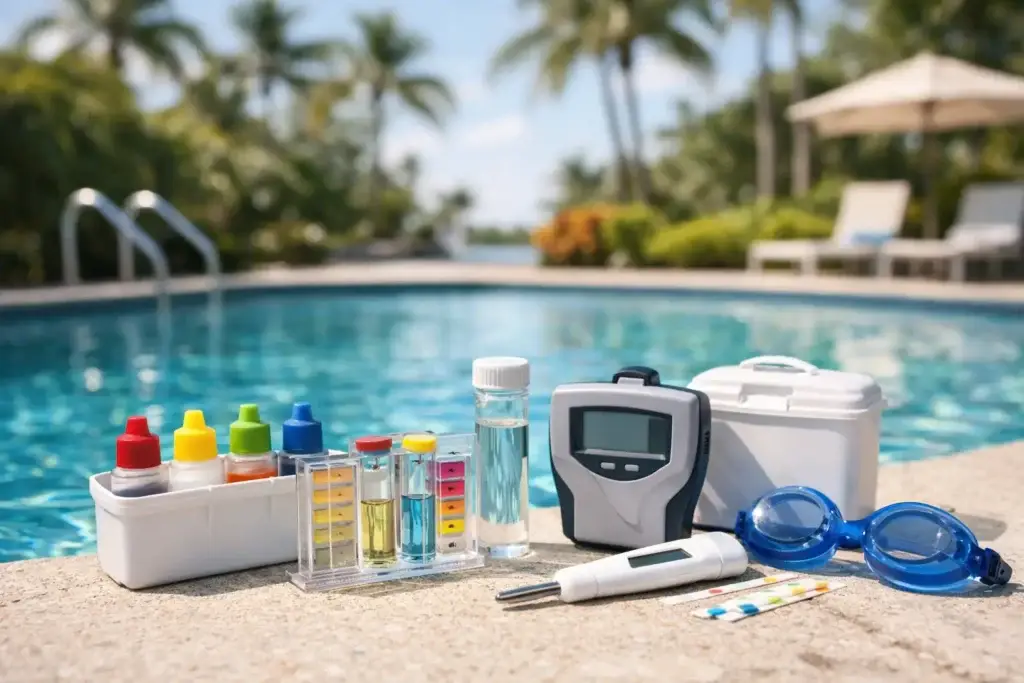
A pool can look clear and still be out of balance. That is why the best pool test kits do more than confirm there is chlorine in the water. They help you spot the chemistry changes that lead to cloudy water, irritated eyes, scale, algae, and unnecessary wear on equipment.
For pool owners in Southwest Florida, testing is not a once-in-a-while task. Heat, afternoon rain, heavy swimmer use, pollen, and long sunny days can all change water chemistry quickly. The right kit gives you useful information. The wrong one can create false confidence or leave you guessing at a color that falls somewhere between two tiny squares.
What a Pool Test Kit Needs to Measure
Before choosing a kit, focus on the readings that actually affect day-to-day pool health. At minimum, a useful residential pool kit should test free chlorine, pH, total alkalinity, and cyanuric acid, also called stabilizer. These readings tell you whether sanitizer is available, whether the water is comfortable and non-corrosive, and whether Florida sunshine is burning chlorine away too quickly.
For many pools, calcium hardness matters too. Low calcium can make water aggressive toward plaster and some equipment components, while high calcium can contribute to scale on tile, heaters, salt cells, and finishes. Saltwater pool owners should also have a reliable way to check salt level. Salt is not a sanitizer test by itself, but it tells you whether the salt chlorine generator has the proper supply to do its job.
A good kit should separate free chlorine from total chlorine. Free chlorine is the active sanitizer. When total chlorine is much higher than free chlorine, combined chlorine may be building up. That is often a sign the pool needs attention, especially after heavy use, storms, or an early algae issue.
The Best Pool Test Kits by Type
There is no single best choice for every pool owner. The right option depends on how much accuracy you need, how comfortable you are handling reagents, and whether you want to manage pool chemistry yourself or simply keep an eye on a professionally maintained pool.
Best overall: Taylor K-2006
For homeowners who want dependable, detailed results, the Taylor K-2006 is one of the strongest all-around choices. It uses a FAS-DPD chlorine test, which is more precise than matching a shade of pink in a basic comparator block. You count drops until the sample turns clear, giving you a specific free chlorine reading rather than an estimate.
It also tests pH, total alkalinity, calcium hardness, and cyanuric acid. That makes it a solid fit for traditional chlorine pools, saltwater pools, and homeowners who want to understand why the water is changing instead of just adding products until it looks better.
The trade-off is time. This is not a 30-second strip test, and there is a short learning curve. But once you have used it a few times, the process is straightforward. For a pool that has recurring water issues, a quality drop kit is usually worth the extra effort.
Best for saltwater pools: Taylor K-1766 salt test
Saltwater pool owners often rely too heavily on the number shown by their salt system control panel. That display is helpful, but it can drift over time or reflect a reading taken under less-than-ideal operating conditions. A dedicated salt test kit gives you an independent number before deciding whether to add salt or investigate the cell.
The Taylor K-1766 is designed for this job. It provides a titration-based salt reading that is more useful than guessing from strips, particularly when the generator reports low salt but the water chemistry appears normal. Pair it with a full chemistry kit rather than treating it as a complete testing solution.
Best for quick routine checks: Quality multi-parameter test strips
Test strips are convenient, fast, and easy to keep near the pool equipment. A reputable multi-parameter strip can be useful for checking chlorine, pH, alkalinity, stabilizer, and sometimes hardness in under a minute. They are a practical choice for a quick midweek check between regular service visits.
Their weakness is precision. Humidity is hard on strips, and Florida garages and pool cages can get hot and damp. Always close the container immediately, avoid touching the pads, and do not use strips that are expired or have been left open. Read them in good natural light and follow the timing instructions exactly.
Strips are best used as an early warning tool. If a strip shows a surprising result, confirm it with a drop kit or have the water professionally tested before making a large chemical adjustment.
Best digital option: A pool photometer
Digital photometers, such as the PoolLab 2.0 and similar water-testing devices, use tablets or reagents and provide numeric readings on a screen. They can be appealing for homeowners who dislike color matching and want a record of results over time.
A good photometer can test a broad range of chemistry values with consistent results when used correctly. It is especially useful for owners of high-value finishes, pools with heaters, or rental properties where several people may be responsible for recording readings.
The downside is cost and upkeep. Digital testers still require clean sample cells, fresh tablets or reagents, and careful handling. They are not maintenance-free. A low-cost digital reader with limited tests is not automatically better than a well-made drop kit.
How to Get Reliable Results From Any Kit
Even the best kit cannot correct a poor sample. Take water from elbow depth, away from return jets, skimmers, and floating chemical feeders. Testing water directly beside a tablet feeder or fresh chemical addition can give you a misleading result.
For the most useful comparison, test at about the same time of day. In Florida, late afternoon readings can look different from early morning readings because sunlight, swimmer load, and rainfall affect chlorine demand. After a major storm or a pool party, test again before assuming your normal chemical routine is still enough.
Store liquid reagents indoors where possible. Extreme heat shortens their useful life, and old reagents can produce inaccurate numbers. Replace them according to the manufacturer’s date guidance and label bottles when they are opened. A kit is only as accurate as the materials inside it.
Readings That Deserve Attention
A test kit is valuable only if the results lead to the right next step. Free chlorine should be appropriate for your stabilizer level, not treated as a fixed number for every pool. A pool with higher cyanuric acid generally needs more free chlorine to stay properly sanitized.
pH commonly rises in pools with salt systems, water features, or frequent aeration. Allowing it to stay high can encourage scale and dull water. On the other hand, repeatedly pushing pH too low can be hard on surfaces and equipment.
Alkalinity helps stabilize pH, while calcium hardness protects certain surfaces from aggressive water or scale-forming conditions. These readings work together. Correcting one number without considering the others is where many DIY chemistry problems begin.
If water is turning green, cloudy, or foamy, do not depend on a single chlorine strip result. Check free chlorine, pH, stabilizer, filtration, circulation, and visible debris. Algae prevention is not just about pouring in more chlorine. It is about maintaining a balanced system and keeping the pool clean enough for sanitizer to work.
When Testing at Home Is Not Enough
Home testing is useful, but it does not replace consistent maintenance. A test kit cannot brush algae from walls, remove debris from a filter, clean a salt cell, find a failing pump, or correct a neglected pool before staining becomes permanent.
That is why many homeowners use a kit for quick checks while leaving weekly water balancing and equipment care to a professional. At Florida Detail Pools, we see the difference that regular testing, cleaning, and preventative attention make, especially during the hottest and wettest parts of the year.
Choose a kit that matches how involved you want to be. Keep it stored properly, use it consistently, and treat unusual readings as a reason to look closer before a small chemistry issue becomes a green-pool cleanup.